The 3 U's of Process Mapping
Michael Cousins // Managing Director
Over the years, in many of the conversations I have had with business analysts, process mappers, line managers, improvement professionals and senior directors, there has been a common thread of questions regarding process documentation that goes something like this:
“How can I get the staff in my company to make more use of the process documentation we create for them?”
And as I’ve thought more and more about this, I have realised that it boils down to what I will call the 3 ‘U’s of Great Process Libraries.

Great Process Libraries are Useful, Usable, and Used. By contrast, all other Process Libraries are a waste of time and space.
So, what makes a Process Library Useful?
- It contains information the reader is interested in knowing
- The information is accurate
- The information is complete
- If the person performs the process as described, they get the outcome they are expecting
And how about Usable?
- The information can be understood by the intended audience
- The information can be accessed quickly, and ideally more quickly than any other possible means
- The user interface to the information is simple enough to require virtually no training
And what about Used?
- Staff understand that changes to the process are communicated via the Library, and therefore reference it periodically
- Core business processes refer to the Library (things like appraisals, inductions, performance reviews, job descriptions and job interviews)
- Management regularly review the processes in the Library together with the staff responsible for performing those processes
- A visually engaging interface itself attracts usage
So, let’s look at some of the ways in which you can make your Process Library more Useful and Usable, and thereby achieve the all important Used.
How to make a Process Library more Useful
A Useful Process Library contains accurate and complete information that people want.
Accuracy is an essential aspect of a Useful Process Library. But Accuracy is surprisingly difficult to achieve, especially when there are subjective aspects as to what is or is not correct, and when the processes themselves are changing on a regular basis. There will generally need to be compromise. But the most important insight to gaining accuracy is that it must emerge as a consequence of an effective governance model for the Library content, not as the result of individual or team ability.
Process Library Governance can be thought of as the set of Roles and Responsibilities that collectively ensure process content is always accurate and complete. And in its simplest implementation, it can be thought of as effective sign-off and change control.
The most basic form of Process Library Governance, and the start point for governance implementation, is to ensure effective sign-off of Process Library content.
If the content of your Process Library is not subject to formal sign-off, that is performed well, then the Library will be unlikely to ever achieve the required levels of accuracy and completeness that make it Useful.
As a minimum, Triaster recommend sign-off on at least 2 dimensions for every piece of content:
- Content. Is the content accurate, complete, relevant and appropriate for the intended users.
- Compliance. Does the content comply with the organisation’s standards for symbology, colour, business rules etc.
How to make a Process Library more Usable
This is all about attention to detail in the interface and getting the basics right. Assuming the content is Useful, Usability is providing ways for the end user to:
- Find the content fast
- Read it on-line, print it, fill it out, link to the procedure, navigate to the next step, ...., or whatever it is they need to do easily
It really is as simple as that. So why oh why oh why do companies persist in loading whole swathes of non-searchable, unlinked images and documents to network drives in the belief that this is providing a management system people can Use?
Xtrac
A great example of a high impact design promoting interest.
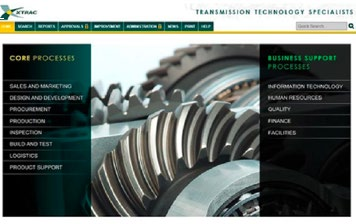
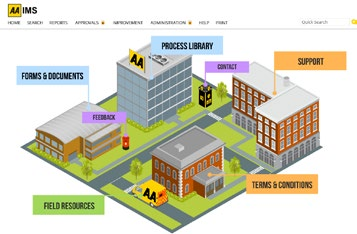
Within the Triaster customer base, there are many brilliant examples of visually engaging interfaces. Each of them has been designed to take into account the culture of the organisation, the skill set of the end user, the information needs they have and the organisation’s brand identity. They are all quite exceptional and really help to drive up usage. Take a look at a couple of examples below. My particular favourite is The AA’s because of the appealing way that the AA’s brand is incorporated in their library design.
The AA
The AA incorporated their brand into their Process Library in a playful way, making sure it’s users are excited to use it.
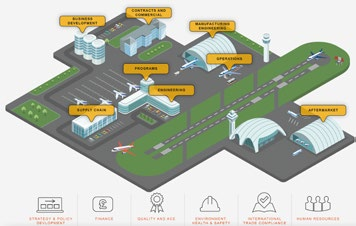
Actuation Systems (Collins)
When Actuation Systems (Collins) began designing their Process Library the end user experience was the most important aspect. Their mission was to provide the user with the exact information they need, in a maximum of three clicks, in a visually engaging way.
Once there is a visually engaging interface, the next step to driving up usage is to repeatedly and consistently link to the Library from all forms of documentation that refer to processes. There are two fundamental sources of opportunities to create links:
- From operational sources, i.e. the documents that discuss or control the ways in which things are done today
- From change control sources, i.e. the documents that discuss or control the ways in which things are done differently in future
On the first of these, there are all kinds of business processes that exist that would benefit from integration with the Library. Induction, appraisal, recruitment, sales, marketing, design, product development, ...., the list goes on and on. How many of these processes have working documents (forms, procedures, templates, policies, procedures) that are not linked to and from the relevant processes in the Library? When you start to create the cross-links, then Usage will steadily start to increase as a by-product.
On the second of the points, is your Process Library integrated with your change control process for the wider organisation? If not, then it needs to be. Business change should be tied to library versions as a mandatory step in the change control process. For each change project, there should be a corresponding release of the Process Library that contains the process definitions for the changed circumstances. In this way, people will associate the Library as the most accurate and relevant source of information pertaining to the way things should be done today.
How to make a Process Library more Used
Of course, Useful Usable content is a pre-requisite. If your Library is suffering from content or interface issues then these must be addressed first. It is only when the people can get to the information they need fast, and benefit from having it that you have a fighting chance of driving up usage. So, let’s assume you have a Useful, Usable Library - how can you drive up usage?
Firstly, try to engage the users’ imagination - we are all human, we like to be interested in things, we want to spend our time looking at things that interest us or entertain us. This is such a basic human property and it is relatively easy to take advantage of with modern web tools.
As a final thought on Usage, consider also the needs of your users to be pro-actively communicated with, trained, kept informed and kept interested. These things go a long way to ensuring the Library embeds itself as the standard reference source for process documentation. One of the great ideas I have heard over the years is a Library treasure hunt! Embedded in various process documents are treasure symbols, and staff are provided clues as to where the symbols are. The first person to find all the symbols wins a small prize. Techniques such as this are fun and help the user learn in a straightforward way how to use the Library and what it is there for.
To find out how Triaster can help you implement a Process Library and help you achieve consistency of processes, call us on us on +44 (0)870 402 1234 or e-mail info@triaster.co.uk. We look forward to hearing from you.